4 images describing nanofluidic implants

Nanofluidic implants for treatment and prevention of chronic diseases (nDS)

The nanochannel drug delivery system (nDS) is a long-acting platform for continuous release of therapeutics to treat or prevent chronic diseases. At the core of the nDS technology is an implantable silicon nanofluidic membrane for controlled drug delivery, where drug- and tissue- agnosticity allows diverse therapeutic indications.
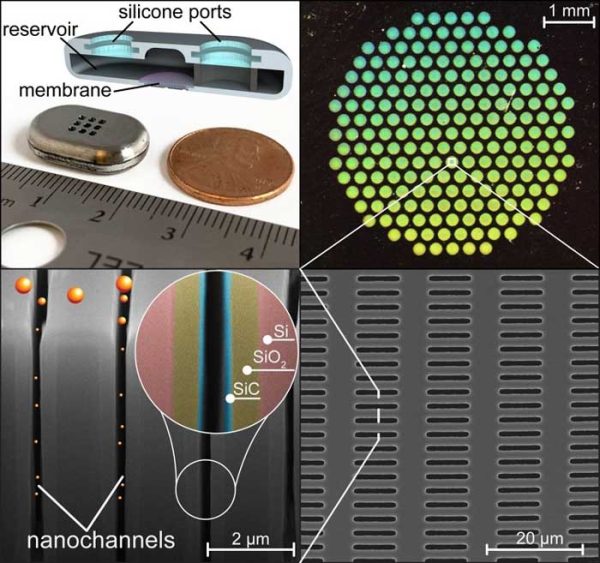
The nanochannel drug delivery system (nDS) is a long-acting platform for continuous and sustained release of therapeutics to treat, manage or prevent chronic diseases. At the core of the nDS technology is an implantable silicon nanofluidic membrane for controlled drug delivery, where drug- and tissue- agnosticity allows diverse therapeutic indications. The membranes are microfabricated and the nanochannnel size, numbers and surface properties can be tuned to achieve the desired release rate of therapeutics of any molecular size.
The nDS holds promise to improve chronic disease outcomes by addressing medication nonadherence. As a long-acting sustained release platform, the nDS maintains drug levels within the desired therapeutic window without fluctuations for maximal efficacy and minimal adverse effects. To extend drug release duration, transcutaneous refilling of solid drug formulation is achieved via a minimally invasive, rapid injection procedure through the silicone ports. The nDS is validated across a variety of clinical indications in small and large preclinical disease-relevant models. Our current therapeutic focus includes HIV pre-exposure prophylaxis (PrEP), where clinical translation of the nDS could realize the potential global health impact of preventive adherence.

Remotely controlled tunable drug delivery devices

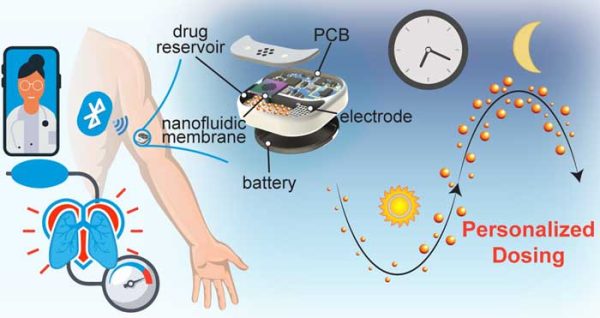
The remotely controlled implant allows tunable drug delivery via an app for personalized dosing.

Our remotely controlled implant allows for tunable drug delivery via FDA-approved low–energy Bluetooth through an app on a mobile device or computer. The implant adopts buried polySilicon electrodes within a silicon nanochannel membrane to control drug release via low-voltage electric potential. The generated electric field creates an ionic redistribution inside the channels that electrostatically gates the transport of drug molecules. We are currently investigating remote controlled delivery in preclinical models for chronotherapeutic or telemedicine applications. Our innovation could advance the field of personalized medicine, where dosing is programmed according to individual need.

diagram of 3rd printed cell encapsulation

3D printed cell encapsulation device for endocrine cell transplantation (NICHE)

The NICHE is a polymeric implant for endocrine cell transplantation within a fully vascularized microenvironment with local delivery of immunosuppressants to improve transplant outcomes.

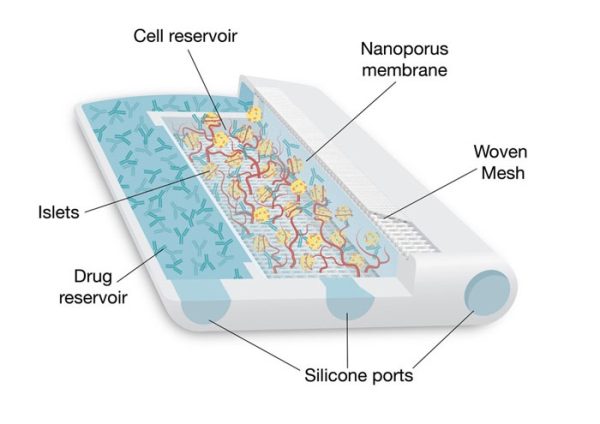
The Neovascularized Implantable Cell Homing and Encapsulation (NICHE) platform is a 3D printed polymeric implant for endocrine cell transplantation. The key innovation of the NICHE lies in the integration of a fully vascularized transplant microenvironment and local delivery of immunosuppressant drugs within the same implant. Immunosuppressants are released from the drug reservoir across a nanoporous membrane directly into the vascularized transplant reservoir. This unique design limits immunosuppressant delivery to the transplant site to prevent immune rejection of transplanted cells, while the vascularized microenvironment supports long-term engraftment. As such, transplant recipients are spared from the toxic side effects of whole-body immunosuppression. Easy loading and refilling of drugs or cells are achieved through silicon ports via a simple injection procedure. We have investigated the NICHE in small and large preclinical models, as a step toward clinical translation. Our therapeutic focus includes Type 1 Diabetes management using pancreatic beta islets. The NICHE could transform the treatment or management of endocrine diseases that cannot be effectively addressed by existing pharmaceuticals, such as Type 1 Diabetes.

diagram of intratumoral drug delivery

Nanofluidic Drug-Eluting Seed for intratumoral drug delivery (NDES)

The NDES is an intratumoral implant for continuous local drug delivery to improve cancer treatment efficacy while avoiding toxic, systemic drug exposure.
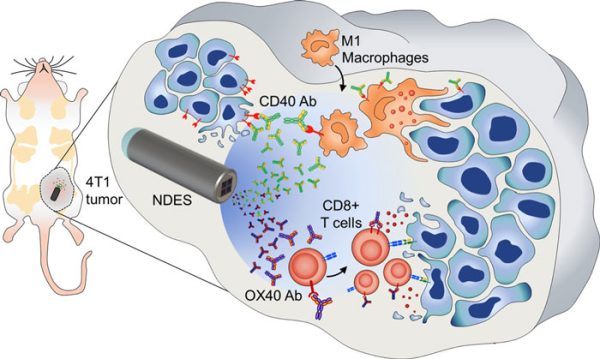
The NDES is an intratumoral implant smaller than a grain of rice that uses a silicon nanofluidic membrane for continuous, controlled local drug delivery. The NDES is inserted directly into the tumor via a minimally invasive clinical trocar method similar to brachytherapy seed insertion. By delivering therapeutics directly to the tumor where it is needed, the NDES could improve treatment effectiveness and avoid exposing the rest of the body to harmful side effects of the drugs. The NDES is drug- and tumor-agnostic and can be adopted as a drug-eluting radiopaque fiducial or adapted for image-guided theranostic approaches. We have investigated local delivery of chemotherapy, immunotherapy, and imaging contrast agents in various murine cancer models. Current therapeutic focus entails intratumoral immunotherapy, based on the premise that local priming of the anti-tumor immune response can yield durable systemic immunity with minimal toxicity. Combination studies of intratumoral immunotherapy with radiotherapy are currently ongoing in various murine models of cancer, including breast cancer and pancreatic cancer. Our innovation aims to change cancer treatment paradigm in a safer and more effective manner.

diagram of In situ immunomodulation for vaccinations

In situ immunomodulation for vaccinations (NanoLymph)

The NanoLymph is a vaccine platform that acts as an immunostimulatory niche to generate antigen-specific immune responses through the continuous release of immunomodulatory agents.

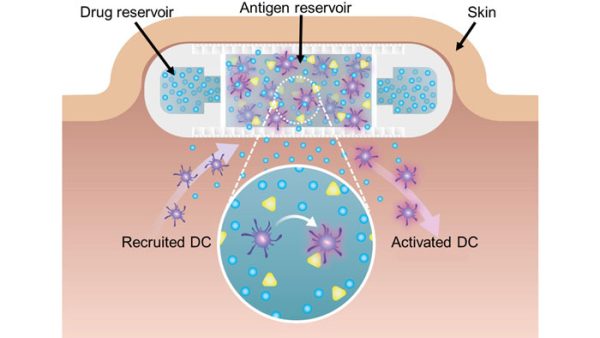
The NanoLymph is a 3D printed vaccine platform that acts as an immunostimulatory niche to generate antigen-specific immune responses through the continuous release of immunomodulatory agents. The NanoLymph has two reservoirs to house immunostimulatory drugs and antigens, respectively. Continuous drug release stimulates dendritic cells (DC) recruitment and immune activation against relevant antigens with the goal of achieving durable memory responses. Current studies focus on prophylactic and therapeutic cancer vaccination in murine triple negative breast cancer and melanoma. Due to flexibility in immunomodulatory agents and antigens, the NanoLymph can be used for other clinical indications including allergy immunomodulation and vaccination against common infectious diseases.

4 international space station program badges

Microgravity research on the International Space Station

The Center for Space Nanomedicine aims to develop nanotechnology for biomedical use on-Earth and in space.

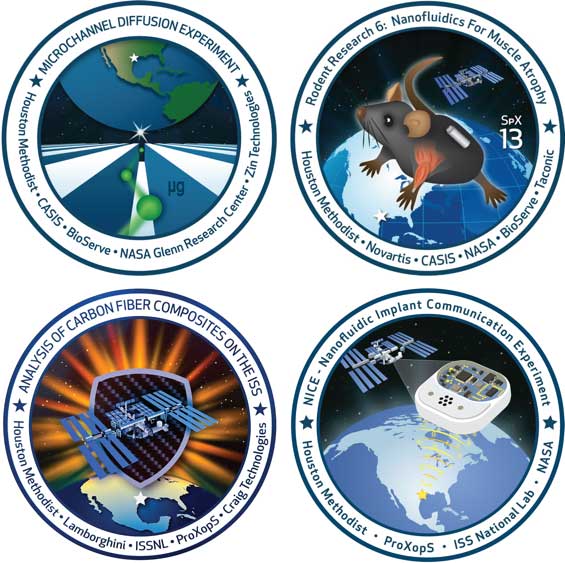
The Center for Space Nanomedicine was founded to develop nanotechnology for biomedical use on-Earth and in space. Studies investigated on the International Space Station (ISS) National Laboratory aim to develop telemedicine innovations and examine new theories on nanoscale diffusion in microgravity environments and under orbital velocity movement. By working with CASIS and NASA and executing experiments in this unique environment, we have expanded the scope of scientific investigation at nanoscale levels. We are currently working on different projects in collaboration with the ISS National Laboratory, including:

  • Investigation of the effect of outer space on carbon fiber reinforced polymers provided by Automobili Lamborghini (Learn more)
  • Testing of the remotely controlled nanofluidic implant on the ISS (Learn more)
  • Testing of sustained delivery implant for an anti-hypertrophy drug in a murine model aboard the ISS, in collaboration with Novartis (Learn more)
  • Investigation of microfluidics transport physics in microgravity (Learn more)